Spring break starts Monday March 23rd
Classes resume Monday March 30th
Have a Great Spring Break!

At UWest, we believe in educating the whole person. We were founded in 1991 as an alternative to the conventional university experience, integrating liberal arts traditions with a global perspective and drawing from Buddhist wisdom to create a community of collaboration and cooperation. Our graduates meet the challenges of an increasingly complex and globally interdependent world with creativity and compassion.
We are a community committed to learning with, from, and on behalf of others. UWest students seize the opportunity to realize their purpose and develop their personal values while following a personalized path to academic success. We think your education should be as unique as you.
We recommend that you access Moodle using Firefox or Google Chrome. Be sure to upgrade your browser to the latest version. Users running other browsers may encounter some technical issues when navigating Moodle.


Preparation for college-level reading. Focus includes critical & analytical reading skills for academic texts, information literacy skills for college writing, & academic vocabulary.

This seminar examines the politics and ethics of knowledge through the lenses of narrative, attention, and authority. Humans make meaning through stories, beliefs, and evidence. How do those narratives shape individuals, communities, and public life? We examine how knowledge claims are constructed, evaluated, and lived, bridging religion, science, history, media, and technology. This course is discussion-intensive, practice-oriented, and project-based. You will engage with readings, films, experiential practices, and media artifacts to build habits of care with attention, interpretation, and public expression. This is not a course about easy answers but about better questions.


Our world is constructed through communication-- it's worth taking a deeper look into how language works. We’ll tackle asking important questions like “how did language originate?” “How does language change over time?” “How does speech occur?” “How do humans learn languages?” and many others. This course provides foundational knowledge, approaching the study of language from a variety of sub-fields including language acquisition, sociolinguistics, phonetics/phonology, pragmatics and semantics, morphology and syntax, discourse analysis, and philosophy / politics. Each section of the course will provide insight into what language is, and different ways in which to examine it.

Introduces fundamentals of algebra with emphasis on quantitative thinking. Reasoning quantitatively using tables & graphs, & application of linear functions, quadratic functions & linear systems to problems is emphasized.

This course will explore the historical views and current perspectives of abnormal behavior, including categorical versus dimensional perspectives. Major diagnostic categories and criteria, individual and social factors of maladaptive behavior, and types of therapy are reviewed. Additionally, various methods of clinical assessment and research strategies are covered. Special attention is paid to the impact of culture on abnormality.

This course provides students with knowledge of the theoretical bases from which to conduct group psychotherapy and the experience to formulate goals, objectives and plans for a psychotherapy group. Students will demonstrate an ability to perceive and describe group dynamics; develop an understanding of the practical issues and problems related to beginning, conducting, and evaluating the group process; demonstrate an ethical foundation and awareness of professional issues; and demonstrate an awareness of self as a group leader

Examines the theories, etiology, assessment, diagnosis, and treatment of alcohol and substance use disorders and addiction through the lenses of resiliency, recovery, medical, and Buddhist psychology models, with special attention to co-occurring disorders.
Congratulations! You have reached the final milestone in your journey to become a licensed professional in the field of Behavioral Science.
Your Comprehensive Exam (Comps) is a testimony to your education, training, and experience you have acquired in our MA-MFT Program at UWest. We are confident that the comps not only validates the efficacy of our training and your dedication, but it also prepares you for the BBS-LMFT licensure examination that you will undertake in the near future.
The comps contains 180 questions and it covers the following areas it their respective percentages:
Clinical Evaluation 27%
Developing a Diagnostic Impression 11%
Managing Crisis Situations 11%
Case Conceptualization and Planning 12%
Treatment 29%
Managing Legal and Ethical Obligations 10%
You will need to obtain answer correctly 80% of 180 questions, or 144 questions, to pass the comps.
To ensure the efficaciousness of this process and the success of passing this exam, we have prepared three (3) practice exams this semester before you take your final exam in April 2025. These practice exams will be held in February, March, and early April 2025 (refer to Course Schedule for details). Each exam has 50 practice questions and needs to be completed in one hour.
All exams are conducted online and timed. If missed, the practice exams cannot be rescheduled. The final exam will be conducted in the Computer Lab on campus (2nd Floor, ED Building) on April 24, 2025. The total time allowed to take the exam is two (2) hours. If a retake is necessary, the second and final date for taking the comps in Spring 2025 is May 8, 2025.
Go well!


Use and interpretation of financial statements; evaluation of accounting information systems; accounting for and analysis of costs; managerial use of accounting data for planning and decision making.


Reviews relevant philosophies; discusses ethics from different religious perspectives, particularly humanistic Buddhism, & emphasizes how such philosophy & ethics can be effectively used in modern organizations & management.
Why This is Important?
How can you be an ethical corporate citizen in an increasingly complex, multiple-stakeholder world?
This is the most pressing question facing businesses today, small and large, local and global. Business Ethics is a thorough yet accessible exploration of the main ethical theories and how these apply to the major stakeholders facing this question.

This course examines aspects of suffering, social engagement, spiritual maturity and leading from within, through a developed meditation practice, ritualized life, awareness of conditioning, perspective taking, and spiritual bypass as seen in traditional and contemporary texts.

This course examines aspects of suffering, social engagement, spiritual maturity and leading from within, through a developed meditation practice, ritualized life, awareness of conditioning, perspective taking, and spiritual bypass as seen in traditional and contemporary texts.

Introduces the art of writing & giving dharma talks. Students identify styles & methods to help them in their own homiletic work while exploring how to relate the professional imperatives of chaplaincy with the imperatives of a Buddhist faith.

This course introduces students to the theories and practices of spiritual care and counseling in the field of professional chaplaincy.

This course examines the ways influential thinkers have understood stages of transformation in spiritual development. Students explore the ways in which significant works may deepen their own personal practice as well as their approach to chaplaincy.


A seminar focused on the development and writing of the Applied Dissertation Project (BMIN) and PhD dissertation (REL).

Course Rationale
Throughout the history of development of Buddhist philosophy and scholaticism, the Abhidharma (Pāli: Abhidhamma) collection of texts sits at the center stage among the Three Baskets (Tripiṭaka) claimed to preserve the deepest terrains of the Buddha’s wisdom. As one of the earliest Abhidharma traditions, the Theravada (Pāli) Abhidhamma aims at comprehensively articulating and analyzing experiential realities and doctrinal points [Dharmā (Pāli: Dhammā)], offering a most systematic, fine-tuning guide for mastering Buddhist philosophy and meditation practice (mental cultivation, bhāvanā) toward liberative insight and realizing the ultimate freedom, the unconditioned Nirvana (Pāḷi: Nibbāna) element. In modern times the Abhidharma philosophy has increasingly been recognized as carrying principal constituents of Buddhist psychophilosophy in light of its exhaustive system of analysis of the mentality-materiality (nāma-rūpa) operated hand-in-hand with the underlying conception/perception of reality shaped within the framework of conditionality and selflessness.
It was based on these over two millennia Abhidhamma texts that fueled the revitalization of mindfulness cum insight (Vipassanā) meditation in Burma in the early 20th century. And through the skillful adaptation and popularization by Jon Kabat-Zinn and others in the last three decades, an adapted mindfulness-insight meditation technique has gradually developed and grown into an array of specific mindfulness-based therapies. Today mindfulness-insight meditation has been used in various physical and mental health conditions with voluminous scientific findings backing up their potential benefit.
'; mso-ansi-language: EN-US; mso-fareast-language: EN-US; mso-bidi-language: AR-SA;">Despite this, the invaluable inheritance of Theravada Abhidhamma can indeed do much more than being simply a therapeutic domain. It provides a logical premise of ethical living, and a thoroughly practical guideline of applying discriminative wisdom to living skillfully that ultimately lands in happiness here and now, and hereafter. For that, a good grasp of important Abhidhamma concepts is crucial. It’s with this aim that this course is introduced and offered at UWest.

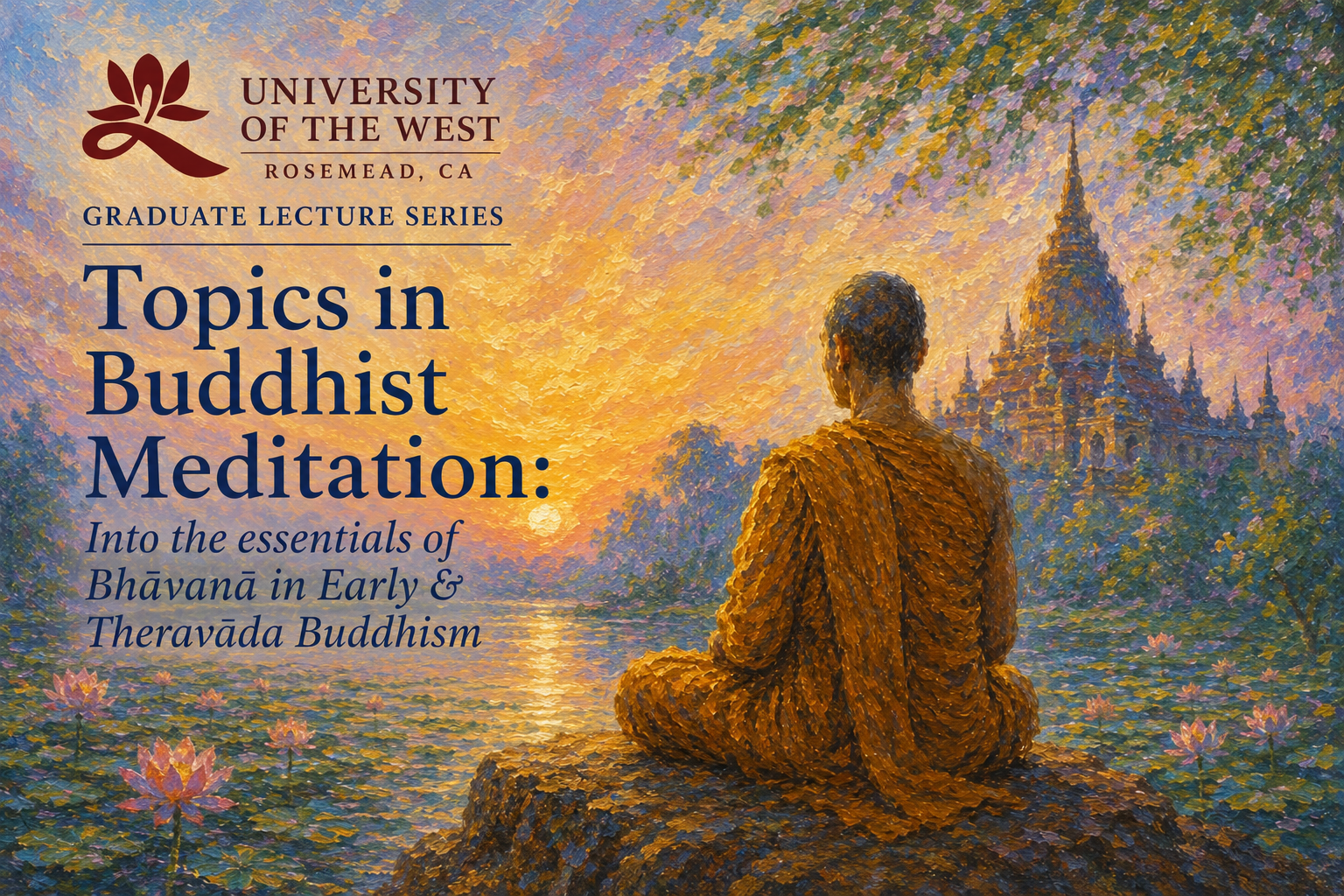
This class is a survey of the doctrinal contexts, theoretical frameworks, and the practice of and approaches to early Buddhist meditation. The course will contain both the emic/practitioner’s perspective as well as the study of meditation as an academic discipline.
Topics to be covered and discussed in this course include (primarily presented in this order): The etymology of meditation; the soteriology of Buddhist meditation; The dynamics of Calm and Insight (śamatha-vipaśyanā); the role of concentration and the nature of attention; mindfulness, clear comprehension, ardency, and other requisites in the culture of Buddhist mental development; meditative absorption/immersion/composure (jhāna); the controversies over jhāna and other aspects of meditation; stages of insight and the supramundane fruitions; eidetic and “antidotal” meditations; and new horizons in the study of meditation and consciousness.

This course examines artificial intelligence as a transformative business technology that reshapes prediction, decision-making, and organizational design. Rather than focusing on technical implementation, the course emphasizes how AI lowers the cost of prediction and how this shift changes judgment, workflows, job roles, and competitive strategy across industries. Students will analyze real-world business applications of AI, evaluate managerial and ethical implications, and develop frameworks for responsible adoption and strategic use. The course equips future business leaders with the conceptual tools needed to understand where AI creates value, how it alters decision processes, and how organizations can integrate AI in ways that enhance human judgment rather than replace it.

A seminar focused on the development and writing of the PhD/DBMin dissertation.
Background Colour
Font Face
Font Kerning
Font Size
Image Visibility
Letter Spacing
Line Height
Link Highlight
Text Colour